

From Remote Control to Onboard Intelligence: A Staircase for AI in Systems Engineering
Celeris Insights | Reflections from SwissED 2026
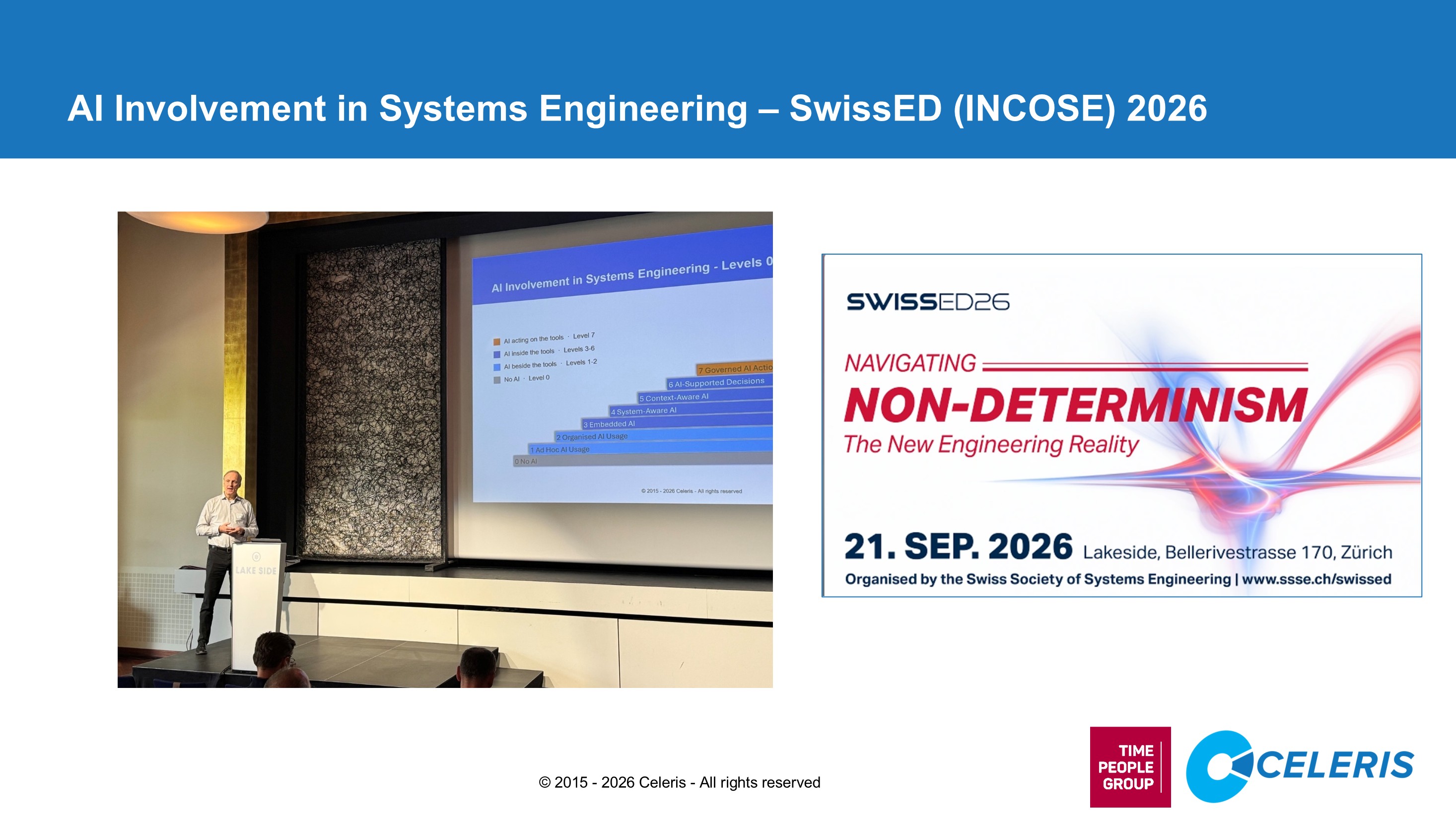
On Monday, 21 September, the systems engineering community met in Zürich for SwissED, the annual conference of the Swiss chapter of INCOSE. This year's theme was "Navigating Non-Determinism: The New Engineering Reality." It could hardly have been more timely. Engineering organisations are built on traceability, repeatability and control, and AI brings a kind of uncertainty they have not had to manage before.
Celeris CEO Anders Ekman presented a model we have developed to help organisations answer a simple question that is hard to answer well: how far has AI actually been adopted in our development organisation, and what would the next step look like?
A personal thirty-year arc
For Anders, the talk had a personal side. In the mid-1990s he researched artificial neural networks and mobile robots at the Swedish National Defence Research Establishment. Computing power was the main constraint. The team never got far in adding intelligence to its robots and relied mostly on remote control, with limited autonomy such as returning to a predefined starting point.
On his flight to Zürich, Anders sat next to a PhD candidate from Stockholm who was on his way to join the robotics research team at ETH Zürich. His research will focus on onboard large language models in mobile robots.
Many ideas that were out of reach thirty years ago are now becoming practical. That applies to robots, and it applies equally to how we engineer the systems around us.
The AI Involvement model
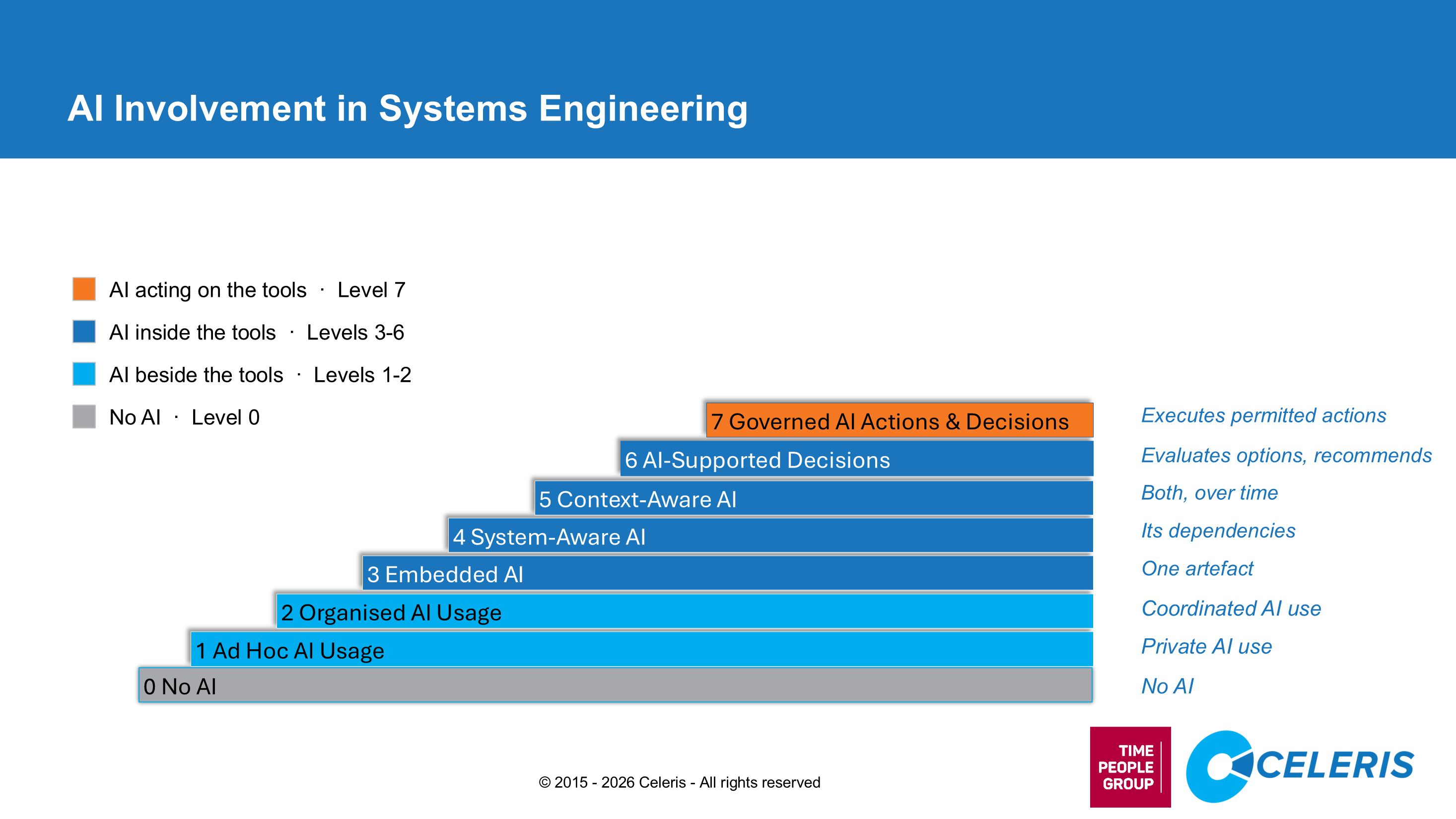
Most discussions of AI in engineering jump straight to the most ambitious scenario: autonomous agents designing and verifying systems. In practice, organisations sit at very different points, and often at several points at once across teams. Our model describes this as a staircase of eight levels: a Level 0 starting point, followed by seven levels grouped into three stages based on where AI sits relative to the engineering tools.
Level 0: No AI. The starting point. Engineering work happens without any AI involvement.
Stage 1: AI beside the tools (Levels 1–2)
Level 1: Ad Hoc AI Usage. Individual engineers use AI assistants privately, for example to draft text, summarise documents or explore ideas. Usage is uncoordinated and mostly invisible to the organisation.
Level 2: Organised AI Usage. The organisation coordinates AI use with agreed tools, guidelines and shared practices. AI is still separate from the engineering environment, but its use is now intentional and governed.
Stage 2: AI inside the tools (Levels 3–6)
Level 3: Embedded AI. AI is built into the engineering tools and works on one artefact at a time, such as a requirement, a test case or a model element.
Level 4: System-Aware AI. AI understands an artefact's dependencies. It can see how a requirement connects to tests, design elements and other requirements, and reason about impact across those links.
Level 5: Context-Aware AI. AI adds the dimension of time, following the artefact and its dependencies as they evolve. It understands how the system has evolved, why decisions were made, and where changes are likely to ripple.
Level 6: AI-Supported Decisions. AI evaluates options and recommends courses of action. Engineers remain the decision-makers, supported by analysis that draws on the full system context.
Stage 3: AI acting on the tools (Level 7)
Level 7: Governed AI Actions & Decisions. AI carries out permitted actions directly in the engineering tools within clearly defined boundaries. Governance determines what AI may do, when, and with what oversight.
Why the staircase matters
The model is not a race to Level 7. Each level builds on the one below it. An organisation cannot safely let AI act on its tools if it has not first established organised usage, structured data and traceable relationships between artefacts. Context-aware AI depends on a well-maintained engineering baseline, and decision support depends on context.
This links directly to the foundations we work on every day across Requirements Management, Test Management, Delivery Management, Engineering Analytics and Model Management. The higher an organisation wants to climb, the more those foundations matter.
The model also gives teams a shared vocabulary. Saying "we use AI" can mean anything from an engineer privately using a chatbot to an agent updating test plans. Naming the level makes the conversation concrete: where are we today, where do we want to be, and what has to be true before we get there?
A note of thanks
Thank you to the SwissED organisers for an excellent conference, thoughtful discussions and a beautiful setting. We warmly recommend it to anyone working in systems engineering.
Where does your organisation sit on the staircase today? Tell us in the comments – we would love to hear your perspective.
#SwissED #INCOSE #SystemsEngineering #AI #Robotics #MBSE or #RequirementsEngineering #RequirementsManagement

