

AI in Practice, Part 1: A Staircase, Not a Leap
Reflections from the INCOSE Sverige Annual Seminar 2026
Anders Ekman, Solution Principal, Celeris Consulting | Celeris Insights, November 2026
On 12 November 2026, INCOSE Sverige held its annual seminar in Stockholm, with SE4AI and AI4SE as the theme of the day. I gave a talk there titled “AI in Practice: From Ad Hoc Use to Controlled AI Actions in Systems Engineering”. This edition and the next share the main points of the talk and a few of its slides. Part 1 covers what we see in practice and the model we use to discuss it. Part 2 covers guardrails, a concrete example and a look ahead.
AI is already in use, but not yet under control
In our customer engagements, AI is rarely absent. More often it is in use privately and without a record. Requirements are pasted into a chat window and the answers are copied back. The same question gets different answers, depending on the engineer and the day. Nothing defines what the AI may read, change or decide.
Systems engineering asks for more than that. A result needs to be checked against agreed rules, consistent in its rules and terms whoever asks, and traceable to its source and to the person who approved it. Our view is that the gap is not the AI. The gap is how People, Process and Tools are adapted for AI use.

From the talk: what we see in practice, and what systems engineering needs.
A staircase of AI involvement
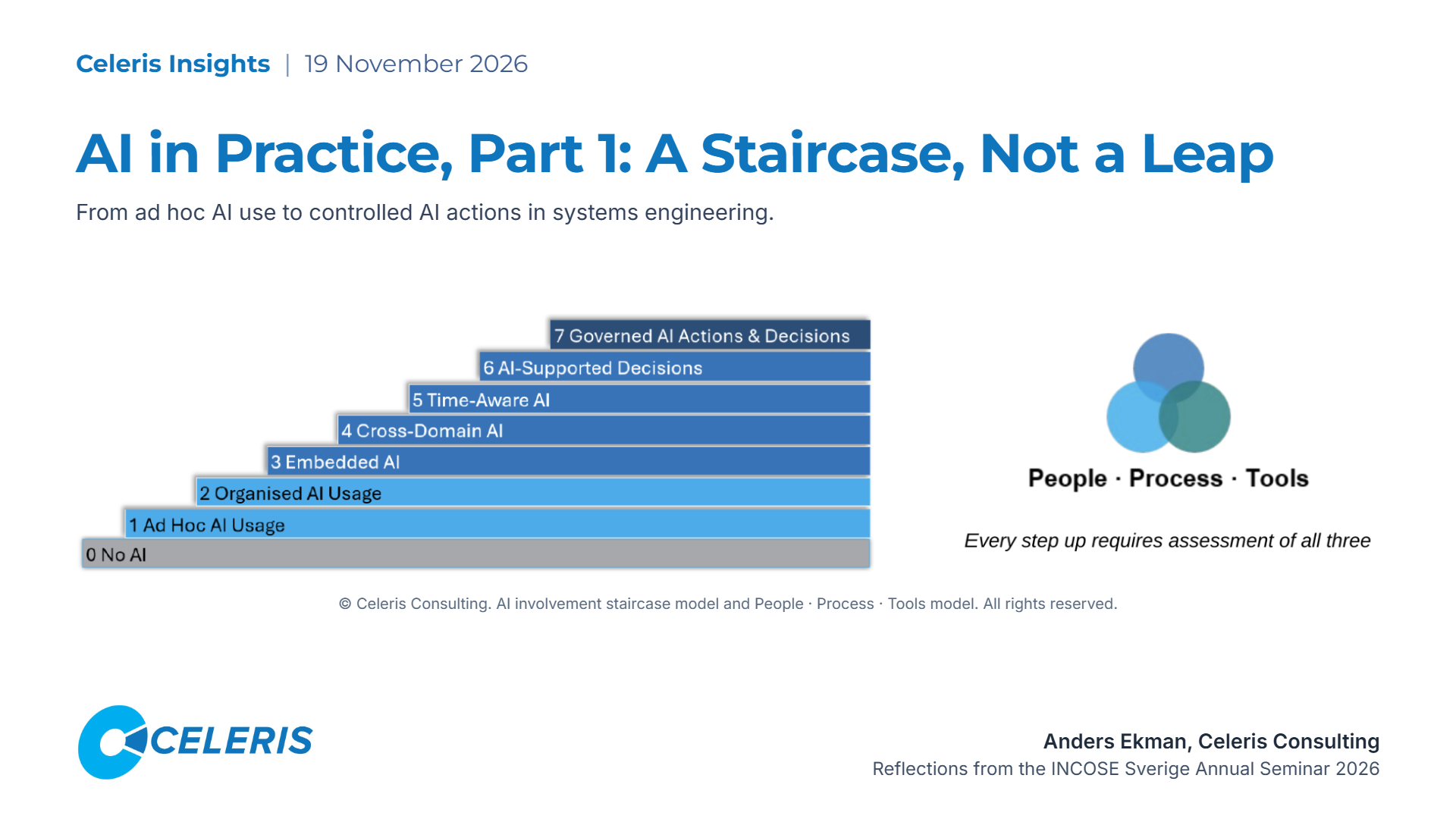
To make the discussion concrete, I presented a practitioner model of AI involvement in systems engineering. Level 0 is the reference with no AI. Levels 1 to 7 describe how AI use develops, in three bands:
- Ad hoc (Levels 1-2): private AI use, then organised use with an approved assistant, a stated purpose and review.
- Embedded, with guardrails (Levels 3-5): AI inside the engineering tools, first on one artefact at a time, then across domains, and then over time with baselines, versions and history.
- Agentic, under control (Levels 6-7): AI prepares options and recommendations for people to decide on, and at Level 7 executes permitted actions within a defined policy.
Two points matter when reading the model. It is a practitioner proposal for discussion and refinement, not an INCOSE standard. And a higher level is not automatically a better target. Level 7 is appropriate only where delegated action adds value and the controls are justified.
Every step up recalibrates People, Process and Tools
In our experience, one of the three dimensions leads at each step, and all three have to follow before the new level holds. Moving from Level 1 to Level 2 is mainly about Process, supported by People: organising the way of working and training people to use the AI well. From Level 2 to Level 4, Tools lead, as the AI moves inside the engineering tools and then across the domains. From Level 5 upward, Process and authority lead, first for decisions and then for governed actions. People run through every step, because each step asks engineers to direct and check the AI in new ways.

Walking up the staircase: every step up requires assessment of People, Process and Tools.
I used one image on stage to separate two ideas that are often mixed. Guardrails keep the car on the road. Control decides who may drive, where, and who answers if something goes wrong. Levels 3 to 5 need guardrails on what the AI produces. Levels 6 and 7 add control over what the AI may decide or do: a policy envelope, approval, logging, reversibility and a named person who is accountable.
Each use case has its own range
I also placed six requirements management use cases on the staircase, from deriving requirements from source documents to document production and compliance reporting. Each bar runs from the level where the use case starts to deliver value to its natural ceiling. Impact analysis of change, for example, adds little below Level 4, because it depends on the links between domains. Rule-based, machine-checkable work such as quality fixes and documentation packs can reach Level 7. Judgement work such as workshops and impact decisions is not a candidate for Level 7.

Use cases by AI involvement level: a practitioner’s view.
The organisation’s practice level is the floor. A use case designed for Level 5, run on a Level 2 practice, delivers Level 2 value.
Accountability stays with people
An AI agent can be responsible for a task. In our view it is never accountable. Up to Level 6, the AI does tasks and people act on the results. At Level 7 the AI may act itself, but accountability still stays with a named person. As I put it at the end of the talk: the question is not how autonomous AI can become. It is how much autonomy you can control.
In Part 2, I look at the guardrail we see as the natural first one, a shared terminology, and at where the engineering tools are heading.
Credits
Author: Anders Ekman , Solution Principal, Celeris Consulting
Editorial Advisor: Maria Ericsson , Expert Advisor, Celeris Consulting
Editorial and Design: Yaru W. , Marketing Coordinator, Celeris Consulting
Learn more about Celeris
- Our LinkedIn:https://www.linkedin.com/company/celerisconsulting
- Subscribe our Newsletter on LinkedIn https://www.linkedin.com/build-relation/newsletter-follow?entityUrn=7491488766507962368
- IBM ELM Widgets: https://celerisconsulting.com/en/tools/ibm-elm-widgets
- Atlassian Jira apps: https://marketplace.atlassian.com/vendors/1227092/reqtech
- Our YouTube channel: https://www.youtube.com/@CelerisConsulting

