


IBM Engineering Lifecycle Management, often abbreviated IBM ELM, is a platform for organizations that need to manage requirements, tests, workflows, changes, traceability, reporting and configurations throughout the entire lifecycle of a system, product or software solution. For companies working with complex requirements management, IBM ELM can create a connected environment where requirements are not isolated documents, but part of a traceable digital thread from need to verified delivery.
In this guide, we go through what IBM ELM is, how the platform relates to requirements management, which core tools are included, how traceability and configuration management work and what organizations should consider when implementing or improving IBM ELM in larger development projects.
What is IBM ELM?
IBM Engineering Lifecycle Management is an integrated tool platform for systems and software development. The platform is used when organizations need to connect several parts of the development work: requirements, design, implementation, testing, changes, configurations, reports and decision support.
The central value of IBM ELM is that information does not have to live in separate documents, spreadsheets and project systems. Instead, requirements, test cases, work items, defects, models and reports can be linked together. This allows the team to see relationships, follow status and analyze consequences when something changes.
IBM ELM is especially useful in environments where development is:
- Complex: Many requirements, many teams, several systems, suppliers or product variants.
- Regulated: Requirements for documentation, traceability, review, audit and compliance.
- Cross-functional: Requirements analysts, developers, testers, architects, security specialists and project management need to work from the same information.
- Long-term: Products, systems or services will be developed, maintained and improved over many years.
- Changing: New requirements, technical decisions and regulatory updates must be handled without losing control.
IBM ELM is therefore not only a requirements management tool. It is a complete environment for engineering lifecycle management. Requirements management is a central part, but it gains its full value when it is connected to testing, workflows, traceability, reporting and configuration management.
Why is IBM ELM important for requirements management?
Requirements management quickly becomes difficult when there are many requirements, when several teams work in parallel or when the organization must demonstrate that a solution meets both customer needs and regulatory requirements. The challenge is rarely only to write requirements. The challenge is to keep requirements current, connected, reviewed, prioritized and verifiable over time.
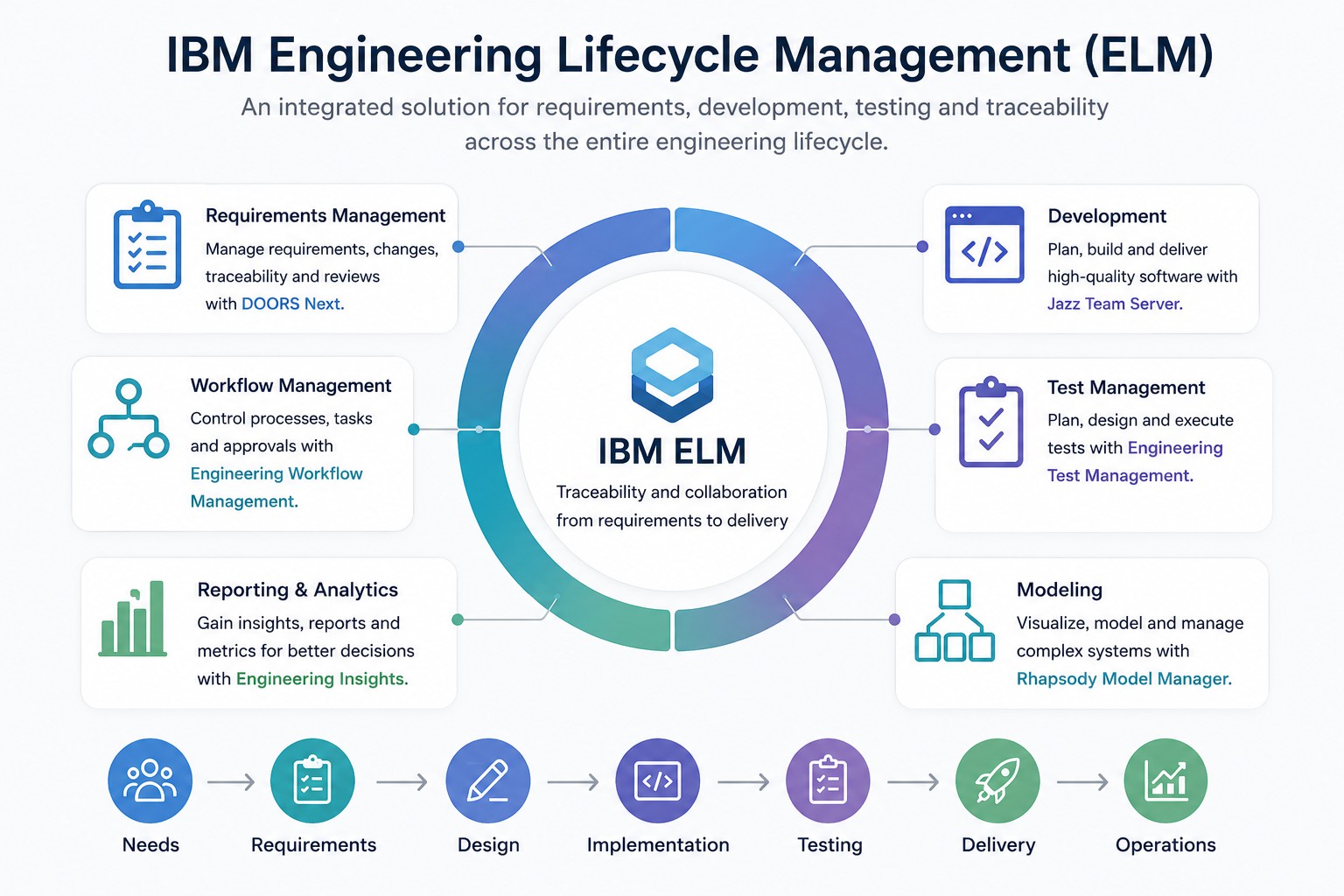
IBM ELM helps organizations create structure around this. Requirements can be managed in DOORS Next, linked to tests in IBM Engineering Test Management, followed up through work items in IBM Engineering Workflow Management and included in configurations and baselines that show exactly which version of the information applies.
The most important benefits
- Control over the requirements lifecycle: Requirements can move from idea and analysis to approval, implementation, test and maintenance.
- Traceability across roles: Analysts, developers and testers can see how their work is connected.
- Better impact analysis: When a requirement changes, the team can analyze what is affected.
- Support for audits and compliance: The organization can show requirements, decisions, links, tests and status in a more structured way.
- Less manual reporting: Dashboards and reports can retrieve information directly from the tool environment.
- Stronger collaboration: Teams work with shared artifacts instead of parallel document versions.
- Better prioritization: Requirements can be connected to risk, value, cost, test status and delivery plans.
For an organization with only a few requirements, IBM ELM may feel larger than the need. But in larger development environments, where requirement volumes are extensive and the relationships are many, an integrated platform often becomes essential for keeping the work together.
Which tools are included in IBM ELM?
IBM ELM consists of several applications and supporting components. Exactly which parts an organization uses depends on licenses, installation, ways of working and needs. In requirements management projects, the following parts are especially important.
| Part of IBM ELM | Main purpose | Importance for requirements management |
|---|---|---|
| IBM DOORS Next | Requirements management | Capture, structure, review, link, trace and maintain requirements. |
| IBM Engineering Test Management | Test management | Links requirements to test plans, test cases, test results and defects. |
| IBM Engineering Workflow Management | Workflows, changes and development work | Links requirements to work items, change requests, defects, plans and implementation. |
| Global Configuration Management | Configurations, versions and variants | Combines the right versions of requirements, tests, design and work items in shared configurations. |
| Jazz Team Server | Common platform services | Supports users, permissions, licenses, project areas and integration between applications. |
| Reporting and dashboards | Follow-up and decision support | Shows status, traceability, coverage, changes and project information. |
| IBM Engineering Insights | Visualization and analysis | Can be used to analyze relationships and gain an overview of engineering data. |
| IBM Rhapsody Model Manager | Model management | Connects requirements to system models, design information and model-based development. |
| IBM Engineering Lifecycle Optimization - Publishing / RPE | Document and report generation | Creates customized documents, requirements specifications, test reports and traceability reports. |
IBM ELM as an ecosystem
It is important to view IBM ELM as an ecosystem, not as a single tool for a single user group. A requirements analyst may primarily work in DOORS Next. A test manager may work more in ETM. A development lead follows work items in EWM. An administrator is responsible for permissions, project areas, configurations and the data model. Management often wants dashboards, reports and risk indicators.
When the environment is configured correctly, these roles can work with their own views and workflows while still contributing to the same overall traceability.
Digital thread and traceability
One of the most important ideas in IBM ELM is the digital thread. This means that information from different parts of the development work is connected so that the organization can follow relationships throughout the entire lifecycle.
In requirements management, this means that a business need can be linked to stakeholder requirements, system requirements, design objects, work items, test cases, test results, defects and delivery status. Instead of each team having its own version of the truth, a common structure is created where the relationships are visible.
Example of a traceable chain in IBM ELM
- Customer need: The customer needs shorter handling time.
- Business requirement: The organization shall be able to reduce manual case handling by 30 percent.
- System requirement: The system shall automatically retrieve and display status data from an external system.
- Work item: A development team receives an implementation task in EWM.
- Test case: The test team creates a test case in ETM that verifies the requirement.
- Test result: The test is executed and the result is linked back to the requirement.
- Report: Project management can see requirement status, test coverage and remaining defects.
This type of traceability is especially valuable when something changes. If a requirement is adjusted, the team can see which test cases, work items and design decisions are affected. This reduces the risk that changes are implemented without understanding the consequences.
Traceability as decision support
Traceability is not only for audits. It also helps the organization make better decisions in everyday work. If a requirement has high risk, lacks test coverage and is connected to several critical components, it should be treated differently from a low-risk requirement without major dependencies.
DOORS Next in IBM ELM
IBM DOORS Next is the requirements management application in IBM ELM. This is where the organization usually captures, documents, structures, reviews and traces requirements.
In DOORS Next, requirements can be managed as artifacts with metadata, links, comments, status, views and relationships. Requirements can be organized in modules, linked to other requirements, included in reviews and linked onward to test cases, work items or other lifecycle artifacts.
What DOORS Next contributes within ELM
- Common requirements repository: Requirements are gathered in a structured environment instead of isolated documents.
- Modules and hierarchies: Requirement specifications can be built with headings, sections and requirements at different levels.
- Attributes and views: Requirements can be filtered by status, priority, type, owner, risk or other metadata.
- Review workflows: Stakeholders can review, comment on, approve or reject requirements.
- Linking: Requirements can be linked to other requirements, test cases, work items, risks and design objects.
- Configuration management: Requirements can be included in streams, baselines and change sets.
- Reporting: Status and traceability can be shown in dashboards and reports.
Testing, workflows and change management
IBM ELM becomes especially valuable when requirements management is connected to testing and development work. Two important parts are IBM Engineering Test Management and IBM Engineering Workflow Management.
Test management with IBM ETM
IBM Engineering Test Management is used to plan, design, execute and follow up testing. From a requirements management perspective, ETM is important because requirements must be verified. By linking requirements in DOORS Next to test cases and test results in ETM, the team can see test coverage and verification status.
- Requirements can be linked to test plans and test cases.
- Test results can show whether the requirement has been verified.
- Failed tests can be linked to defects.
- Reports can show requirements that lack test coverage.
Workflows with IBM EWM
IBM Engineering Workflow Management is used for work items, planning, change management, defects, source control, build flows and follow-up of development work. For requirements management, EWM becomes important when requirements need to be turned into work.
- A requirement can be linked to a development task.
- A defect from testing can be linked back to requirements and test cases.
- Project management can follow status through plans and dashboards.
- Change requests can be handled in a more controlled way through status and decision points.
When requirements, work and testing are connected, it becomes easier to see whether a delivery is actually moving toward completion. It is not enough for a requirement to be written and prioritized. It must also be implemented and verified.
Configuration management, baselines and variants
In large projects, it is not enough to know which requirements exist. You need to know which version of the requirements applies, which requirements belong to a certain release and which artifacts are included in a product variant.
IBM ELM supports configuration management, where teams can work with components, streams, baselines, change sets and global configurations. This makes it possible to manage parallel development, product variants and historical versions in a more controlled way.
Important concepts
- Stream: A workspace where the team can create and change artifacts at a certain development level.
- Baseline: A frozen version of content at a specific point in time.
- Change set: A group of changes that can be kept separate before being delivered to a stream.
- Component: A logical or physical division of a system or product.
- Global configuration: A composition of configurations from several ELM applications, such as requirements, tests and design.
This is especially important when the organization works with several versions at the same time. One team may be developing the next release while another team maintains an earlier version. Without configuration management, it becomes difficult to know which information belongs to which delivery.
Reporting, dashboards and compliance
A common problem in requirements-intensive projects is that reporting is done manually. Someone exports requirements, someone else updates test status, a third person compiles change requests and management receives a report that quickly becomes outdated.
In IBM ELM, reporting can to a greater extent be based on data already available in the tool environment. Dashboards can show status, test coverage, changes, defects, risks and traceability. Customized reports can create material for review, audits, management and delivery documentation.
Examples of reports
- Requirements that lack test cases.
- Requirements changed after the latest baseline.
- Approved and unapproved requirements per module.
- Test status per requirement type, release or component.
- Defects that block verification of requirements.
- Traceability matrices between requirements, tests and work items.
- Reports for compliance, sign-off and audits.
Reporting works best when the data model is well thought through. If requirement types, statuses, attributes and links are used consistently, the reports become much more useful.
IBM ELM in regulated and complex industries
IBM ELM is often used in industries where development work must be both fast and controlled. This can include medical technology, defense, energy, finance, automotive, industry, the public sector and other environments where requirements are numerous and the consequences of errors can be significant.
In such environments, requirements management is not only a matter of methodology. It is also part of the organization’s quality system and compliance work. It must be possible to show what was decided, when it was decided, who reviewed it, which version applied and how the requirement was verified.
- Traceability: Needs, requirements, design, tests and defects can be connected.
- Permissions: Different roles can receive the right access to the right information.
- Review: Requirements and documentation can go through review and approval workflows.
- Baselines: The organization can freeze and compare versions.
- Reporting: Material for audits and management can be created more consistently.
However, to get the value, the tool must be used in the right way. An advanced platform does not automatically create good requirements management. It must be combined with clear ways of working, roles, governance and training.
Implementing IBM ELM step by step
A successful IBM ELM implementation does not start with the installation. It starts with the organization understanding why the platform is needed and which problems it should solve.
1. Map the current situation
Analyze how requirements, tests, changes and reporting are handled today. Which tools are used? Where is duplicate work created? Where is traceability missing? Which reports take the most time to produce?
2. Define the target state
Decide what IBM ELM should achieve. This may be better traceability, easier compliance, fewer manual reports, safer change management or better test coverage.
3. Create a requirements and artifact model
Decide which types of requirements and artifacts you need. Define attributes, statuses, links, views and modules. The model affects how easy it will be to search, filter, review, report and trace.
4. Define the traceability model
Decide which relationships are important. Not all links need to be created everywhere, but the links that are created should have a clear purpose.
5. Start with a pilot area
It is often better to start with a limited project or product area than to introduce everything everywhere at the same time. A pilot makes it possible to test the data model, way of working, training, reporting and governance.
6. Train users and administrators
IBM ELM affects many roles. Requirements analysts, testers, developers, project managers and administrators need to understand both the tool and the process.
Process, roles and responsibilities
IBM ELM is powerful, but the value appears only when the tool environment supports a clear way of working. If the process is unclear, the tool will often reflect that uncertainty.
Roles that are often needed
- Requirements lead or requirements analyst: Responsible for requirements structure, requirement quality and dialogue with stakeholders.
- Product owner or customer representative: Prioritizes requirements and makes decisions about value and scope.
- System architect: Assesses technical consequences and connections to design.
- Test manager: Ensures that requirements can be verified and that test coverage exists.
- Development lead: Connects requirements to work items and delivery plans.
- ELM administrator: Manages project areas, permissions, templates, types, attributes and integrations.
- Compliance or quality manager: Ensures that the way of working supports audits, standards and regulatory requirements.
Common mistakes with IBM ELM
IBM ELM can create significant value, but it is also a platform where early incorrect choices can create unnecessary complexity.
1. The tool is introduced without a clear target state
If the organization does not know why IBM ELM is being introduced, the configuration easily becomes fragmented. Start with problems, goals and use cases.
2. The data model becomes too complicated
Too many requirement types, attributes and statuses make the work heavy. The model should be detailed enough for governance and reporting, but simple enough to be used in daily work.
3. Traceability is created without purpose
Not all artifacts need to be linked to everything. Traceability should support impact analysis, verification, compliance and decision-making.
4. Administration is underestimated
IBM ELM requires maintenance. Project areas, permissions, templates, integrations, reports and configurations need owners.
5. Users receive too little training
If users do not understand the way of working, they will create their own shortcuts. This often leads to inconsistent requirements, weak traceability and poorer reporting.
6. Reporting is planned too late
Reports require data. If attributes, statuses and links are not well thought through from the beginning, the reports become difficult to trust.
Celeris and IBM ELM
Celeris works with requirements management, IBM ELM, DOORS Next, training, tool support, custom widgets and specialist support for organizations with complex development environments. This may involve implementing IBM ELM, improving an existing environment, creating better traceability, training users or configuring the tools so that they fit the organization’s processes.
In many organizations, the challenge is not that IBM ELM lacks functionality. The challenge is to use the right functionality in the right way. Celeris can help with requirement types, attributes, statuses, traceability models, reports, dashboards, baselines, global configurations, training and administration.
Do you need help with IBM ELM?
Celeris helps organizations with IBM Engineering Lifecycle Management, DOORS Next, requirements management, test management, workflows, traceability, training, administration and customized solutions for complex development environments.
Contact Celeris, read more about IBM ELM or see training in requirements management.
Frequently asked questions about IBM ELM
What does IBM ELM mean?
IBM ELM stands for IBM Engineering Lifecycle Management. It is a platform for managing several parts of systems and software development, such as requirements, testing, workflows, reporting, configurations and traceability.
Is IBM ELM the same as DOORS Next?
No. DOORS Next is the requirements management part of IBM ELM. IBM ELM is the broader platform that can also include test management, workflows, configuration management, reporting and other engineering applications.
Why is IBM ELM used in requirements management?
IBM ELM is used because requirements often need to be connected to tests, development work, defects, baselines, product variants and reports. The platform helps organizations create traceability and control throughout the entire lifecycle.
Which roles use IBM ELM?
Common users include requirements analysts, systems engineers, testers, developers, architects, project managers, product owners, administrators and quality or compliance managers.
What is a digital thread in IBM ELM?
A digital thread is a connected chain of links between information in the development work. It can, for example, show how a customer need leads to requirements, design, implementation, test cases, test results and delivery status.
What is Global Configuration Management?
Global Configuration Management is used to combine the right versions of artifacts from different ELM applications in one shared configuration. It is important in parallel development, product variants and larger system structures.
When do you need IBM ELM?
IBM ELM is especially relevant when there are many requirements, development is complex, several teams need to collaborate, the organization needs traceability or when audits, compliance and version management are important.
What is most important when implementing IBM ELM?
The most important thing is to start with a clear target state, a well-designed data model, practical workflows, the right level of traceability, good training and a maintenance model for the environment.

